

The Union Cabinet officially approved the Singhpora–Vailoo tunnel project
Union Cabinet Approves Sudhmahadev–Dranga, Singhpora–Vailoo Tunnel Projects Worth ₹9,800 Crore
Strategic Road Infrastructure to Strengthen Jammu–Kashmir Connectivity; Projects Targeted for Completion in Five Years
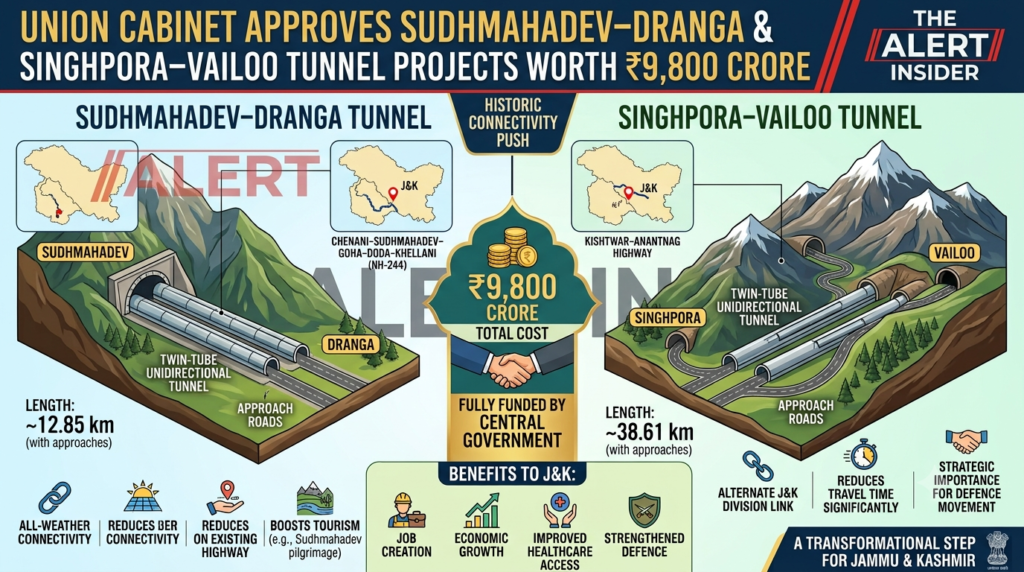
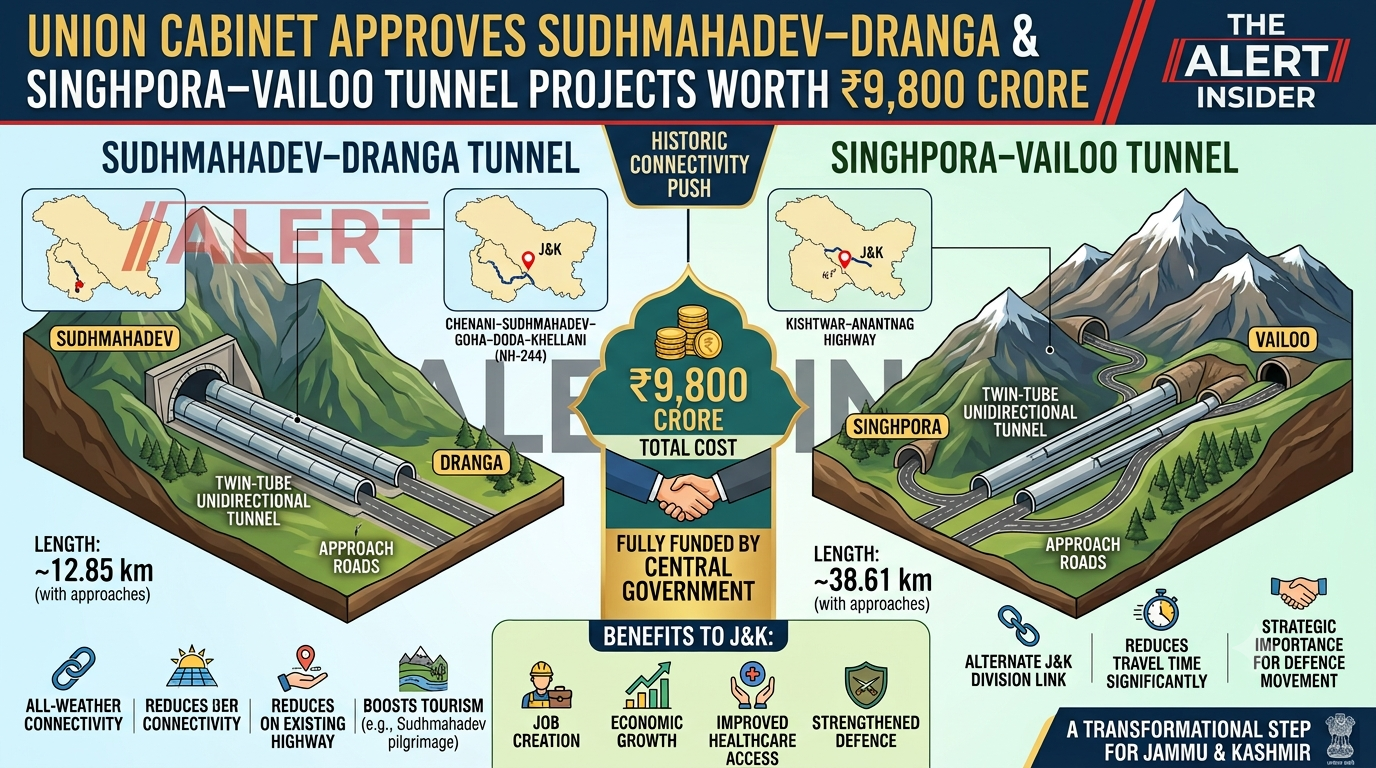
Jammu, Aug 2 (THE ALERT INSIDER: In a major boost to road infrastructure and all-weather connectivity in Jammu and Kashmir, the Union Cabinet, chaired by Prime Minister Narendra Modi, has approved the construction of the Sudhmahadev–Dranga and Singhpora–Vailoo tunnel projects, along with their approach roads, at an estimated cost of ₹9,800 crore.
According to officials, both strategically important projects will be fully funded by the Central Government and are expected to be completed within five years. The tunnels are aimed at providing reliable, year-round road connectivity between the Jammu and Kashmir divisions while significantly improving transportation facilities in Udhampur, Doda, and Kishtwar districts.
The Sudhmahadev–Dranga Tunnel forms part of the Chenani–Sudhmahadev–Goha–Doda–Khellani National Highway, while the Singhpora–Vailoo Tunnel is a key component of the proposed Kishtwar–Anantnag Highway. These projects are expected to serve as alternate road corridors connecting Jammu with the Kashmir Valley, reducing dependence on the Jammu–Srinagar National Highway.
Officials said the 39-kilometre Singhpora–Vailoo stretch will include approximately 10 kilometres of unidirectional twin-tube tunnels, while the 13-kilometre Sudhmahadev–Dranga section will feature an 8-kilometre twin-tube tunnel. In addition to the tunnels, modern approach roads have also been approved to ensure seamless connectivity.
The tunnel projects are designed to bypass difficult and snow-prone stretches of the highways, ensuring uninterrupted movement throughout the year, particularly during winter when higher reaches often remain inaccessible due to heavy snowfall.
The government believes the projects will not only improve travel and reduce journey time but also provide a significant boost to tourism, trade, and economic development across the Chenab Valley and adjoining regions. Improved road access is expected to benefit popular pilgrimage and tourist destinations such as Sudhmahadev and Mantalai, which attract thousands of visitors annually.
Apart from their economic importance, the tunnels also carry strategic significance, providing alternative road connectivity to the Kashmir Valley from the Jammu region, thereby enhancing logistical support and strengthening national security infrastructure.
At present, the Jammu–Srinagar National Highway remains the primary all-weather road link between the two regions, while the Mughal Road connecting Rajouri, Poonch and Shopian remains operational only during fair weather. The recent railway connectivity between Jammu and Srinagar has improved transportation; however, the new tunnel projects are expected to further enhance resilience and connectivity across Jammu and Kashmir.
The approval of these ambitious infrastructure projects is being seen as a major milestone in strengthening regional connectivity, promoting tourism, facilitating economic growth, and improving strategic mobility across the Union Territory.