


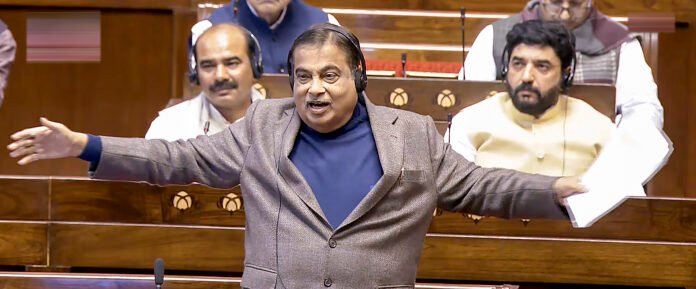
Union Minister for Road Transport and Highways, Nitin Gadkari, announced on Wednesday in the Rajya Sabha that the Multi-Lane Free Flow (MLFF) toll system alongside AI-driven highway management technology will be implemented across India by the end of 2026. This revolutionary approach aims to eliminate waiting times at toll plazas, greatly enhancing the travel experience for millions of commuters.
During the Question Hour, Gadkari detailed that the new tolling mechanism will leverage artificial intelligence, satellite technology, and number plate recognition to facilitate seamless vehicle movement without the need to stop at toll booths. “With MLFF, commuters will not have to stop at toll plazas. Vehicles will be able to cross toll points at speeds of up to 80 km per hour,” he stated, marking a significant upgrade from the existing FASTag system.
The Minister highlighted the progression in toll payment efficiency, stating that the previous waiting time, which ranged from three to ten minutes, has already decreased to less than one minute with FASTag. “FASTag increased our revenue by at least ₹5,000 crore. MLFF is an even better facility, and our goal is to bring waiting time down to zero minutes,” Gadkari elaborated.
This innovative toll system is not just about convenience; it also promises substantial economic benefits. Gadkari anticipates that this new initiative will save fuel worth ₹1,500 crore and bolster the government’s revenue by an additional ₹6,000 crore, while also effectively addressing toll leakage and theft.
“By 2026, this work will be completed 100 per cent. Once implemented, toll theft will end, transparency will increase, and commuters will not face any inconvenience at toll plazas,” Gadkari assured, emphasizing the integrity of the future system. The AI-enabled technology aims to significantly reduce travel time and enhance the overall efficiency of national highways.
The Minister provided clarity on jurisdiction, noting that the central government oversees national highways but not state highways or city roads. He remarked that many issues regarding state and urban roads often circulate on social media, misleading the public into attributing them to national highways. “We are making every effort to ensure a transparent, efficient, and corruption-free system,” Gadkari affirmed.
This announcement represents a significant milestone in modernizing India’s highway infrastructure and substantially improving the ease of travel for road users nationwide. By integrating AI technology in highway management, the country aims to pave the way for a more efficient and user-friendly travel environment.