


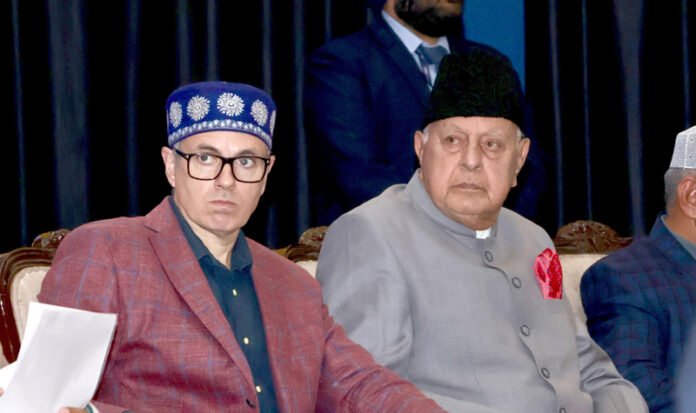
Former Chief Minister Dr Farooq Abdullah announced that Jammu is progressing towards inclusive and sustainable development under Chief Minister Omar Abdullah’s government. Speaking during a meeting with a delegation of the National Conference, Abdullah emphasized that the government has restored public trust in democratic processes.
He remarked, “The Omar Abdullah-led government is making rapid strides to restore people’s faith in democratic institutions.” During the interaction, the delegation expressed concerns about long-standing public issues that they attributed to the previous BJP rule.
The attendees appreciated the corrective measures taken by the current government to reverse the significant setbacks who often plagued Jammu city for over a decade. Dr Farooq Abdullah stated that the National Conference is keenly aware of the hardships faced by the public due to years of undemocratic governance.
Addressing infrastructure projects, Dr Abdullah critiqued the much-discussed Smart City project, indicating that recent rainfall and resulting waterlogging exposed the inadequacies of this initiative. He highlighted effective steps being taken to revitalize the historic Mubarak Mandi heritage complex, which had suffered neglect over the years.
Furthermore, he spoke about the free transport facilities for women, additional ration quotas for underprivileged families, and the revival of the Darbar Move as significant achievements that enhance daily life in Jammu. Dr Abdullah expressed optimism that ongoing projects like ropeways, riverside development, and lake creation would firmly establish Jammu on the national tourism map.
Looking ahead, Dr Farooq Abdullah urged party associates to gear up for upcoming Urban Local Body (ULB) and Panchayat elections, reinforcing public outreach efforts. He emphasized the need for special representation of youth and women in governance to ensure it aligns with their aspirations.
On a parallel front, Chief Minister Omar Abdullah stressed the importance of scientific research to understand climate change impacts on the Gujjar-Bakerwal community. Speaking at the Gurjar Desh Charitable Trust (GDCT) gathering, he encouraged innovative studies to inform future policymaking. Abdullah described Dr Masud Ahmed Choudhary, the late Vice-Chancellor of Baba Ghulam Shah Badshah University, as a visionary who made strides in education.
“There is no dearth of talent in Gujjar institutions. If this talent is channelized into research on climate change, it will strengthen the community,” he stated. He highlighted that the Gujjar-Bakerwal’s nomadic lifestyle poses unique challenges, making them particularly vulnerable to climate change.
Additionally, Abdullah called for improvements within educational initiatives, including Gujjar hostels and mobile schools, urging an objective assessment of the impact of reservation policies. “We have spoken about reservation for years, but serious studies on its real benefits are still lacking,” he noted.
In his address, Dr Farooq Abdullah urged the community to unite and prioritize education as the pathway to securing future generations’ prospects. He maintained that education remains a pivotal factor for empowerment and development.
The event saw the participation of several ministers, MLAs, senior advocates, civil society members, and representatives from the Gujjar community who gathered to commemorate the third death anniversary of Dr Choudhary.