


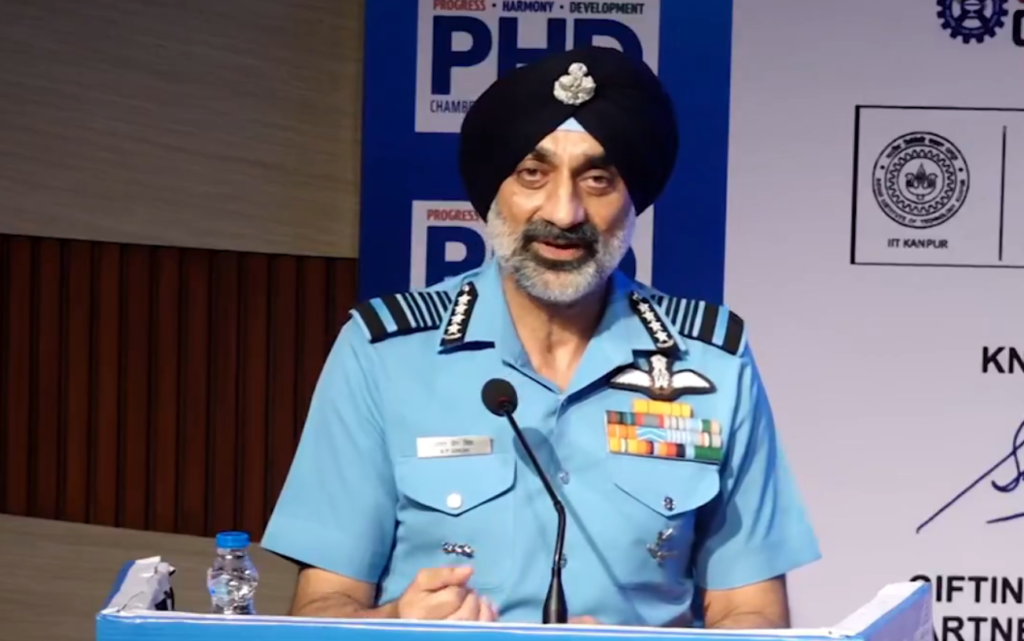
The relentless hum of tomorrow’s battlefield is already being written in India’s design labs and startup hubs. According to the nation’s top air commander, the path to true self-reliance demands an urgent shift in gear.
During the inaugural session of the Bharat Drone & Robotics Manthan 3.0 conference, Air Chief Marshal Amar Preet Singh laid out a bold roadmap for the Indian Air Force (IAF) to foster close collaborations with domestic industry and innovators.
With modern warfare increasingly shaped by cost-effective unmanned systems, the Air Chief emphasised that India’s defence sector must outpace the rapid lifecycle of emerging technologies, where hesitation carries a high operational cost.
Air Chief Marshal Singh underscored that defining precise operational requirements rests with the user, highlighting the newly established Directorate of Aerospace Design (DAD) as a dedicated bridge to engage with startups and innovators.
“The problem statement has to originate from us. We have the Directorate of Aerospace Design… to interact with the industry, startups and anybody who wants to know what the requirement is, what kind of drones, equipment or sensors we are looking for,” he said.
In a bid to streamline evaluation processes, the IAF announced Dronathon 2026 for September, inviting companies to showcase live product demonstrations rather than relying on paper presentations or recorded videos. This initiative serves as a refreshing change, encouraging practical innovation directly from Indian engineers and entrepreneurs.
Pointing out vulnerabilities tied to foreign supply chains, the Air Chief issued a definitive call for domestic mastery. “Every brick should be developed in India. Then only can we claim to be fully Atmanirbhar,” said Air Chief Marshal Singh, reflecting the sentiment of a growing push towards local manufacturing in the defence sector.
Cautioning against bureaucratic delays, he warned that “technology delayed is technology denied,” thereby urging a whole-of-nation approach uniting academia, regulators, investors, and manufacturers to scale solutions from the lab to the operational frontline.
While noting that drones complement rather than replace manned platforms, the IAF’s proactive outreach signals a transformative shift, turning operational challenges into collaborative opportunities for India’s burgeoning aerospace entrepreneurs.
“Technology delayed is technology denied. If we keep doing what we are doing, we will get the same results that we have been getting. If we want different results… let us do something different,” said the IAF Chief, echoing the urgency for a radical transformation within the aerospace sector.