


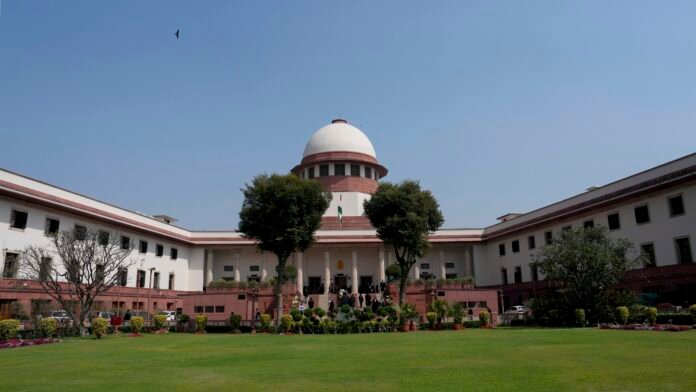
The Supreme Court of India has voiced significant concern regarding a burgeoning trend of judges issuing numerous judicial orders in the waning days of their tenure. Chief Justice of India (CJI) Justice Surya Kant articulated this apprehension, using the cricketing analogy of players ‘hitting sixes in the final overs’ to describe the situation. This observation emerged during the hearing of a petition filed by a Principal District and Sessions Judge from Madhya Pradesh, who contested his suspension that occurred just ten days prior to his scheduled retirement.
During the proceedings, Justice Surya Kant remarked, “It is an unfortunate trend. There is a growing tendency of judges passing so many orders just before retirement.” He stressed that such practices merit closer scrutiny.
The judge, who was set to retire on November 30, was suspended on November 19 after a decision by the Madhya Pradesh High Court. This suspension reportedly stemmed from two judicial orders he passed shortly before his retirement.
Senior Advocate Vipin Sanghi, representing the petitioner, argued vehemently against the suspension. He highlighted the officer’s impeccable service record and questioned the validity of disciplinary action being taken for what he deemed legitimate judicial orders.
“How can an officer be suspended for judicial orders which are appealable and can be corrected by higher courts?” Sanghi posited. The Supreme Court seemed to share some perspective on this, indicating in principle that disciplinary actions typically do not arise from mere judicial errors.
However, CJI Kant raised a crucial point: “But what if the orders are palpably dishonest?” This statement sought to differentiate between genuine judicial errors and cases of misconduct.
On November 20, in a related development, the Supreme Court had instructed the Madhya Pradesh Government to elevate the retirement age for judicial officers from 60 to 61 years. This ruling altered the timeline for the petitioner, pushing his retirement to November 30, 2026. Importantly, the CJI noted that the judicial officer was unaware of this retirement age extension when he issued the disputed orders.
The Bench further probed the rationale behind the judicial officer not appealing directly to the High Court against the suspension. Sanghi clarified that the petitioner deemed it prudent to approach the Supreme Court, given that the suspension followed a Full Court decision.
However, the Supreme Court Bench reminded the petitioner that in the past, Full Court rulings had been overturned by High Courts on account of various judicial proceedings.
Additionally, the Court criticized the judicial officer for attempting to acquire information surrounding his suspension through the Right to Information (RTI) Act. The Bench remarked, “It is not expected of a senior judicial officer to resort to the RTI route. He could have submitted a representation instead.”
Ultimately, the Supreme Court declined to grant immediate relief, yet it allowed the judicial officer to file a representation before the Madhya Pradesh High Court seeking the recall of the suspension order. The Bench instructed the High Court to address and reach a decision on this representation within four weeks.
This incident underscores a crucial concern for the judiciary: the need for accountability and transparency among judicial officers, especially as they approach retirement. The Supreme Court’s scrutiny of this trend aims to ensure that judicial integrity remains intact and that judges prioritize justice over the urgency of their remaining tenure.