


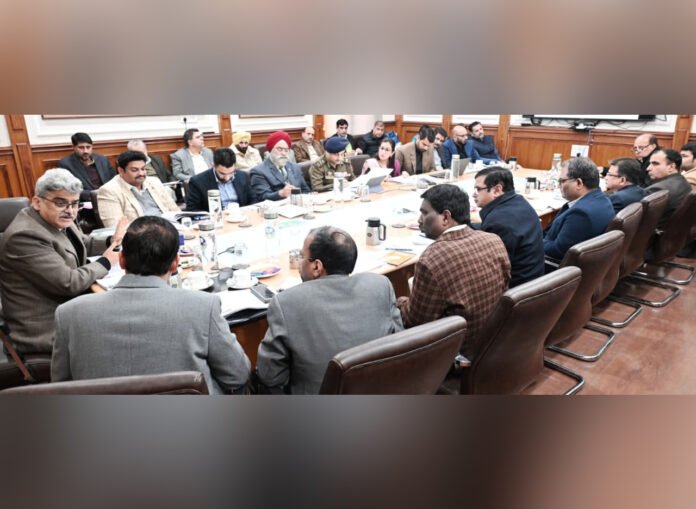
Chief Secretary Atal Dulloo on Wednesday reviewed the implementation of road safety measures in Jammu and Kashmir, as mandated by the Supreme Court, and underscored the need for extensive use of GIS-based data to identify vulnerable and accident-prone road stretches across districts.
Chairing a high-level meeting, the Chief Secretary said that data-driven identification of black spots would enable focused technological, engineering and enforcement interventions, significantly reducing road accidents in the Union Territory. He directed the concerned departments to prepare a clear, time-bound roadmap for the implementation of each Supreme Court directive on road safety.
The meeting was attended by administrative secretaries of concerned departments, senior Traffic Police officers and heads of departments, while Deputy Commissioners participated through video conferencing from their respective districts.
Dulloo emphasised leveraging transport and traffic data to guide targeted safety measures, strategic deployment of traffic police and engineering corrections on stretches prone to frequent accidents. Stressing deterrence as a critical component of road safety, he directed strict punitive action against habitual and serious traffic violators, including cancellation of driving licences, registration certificates and other statutory measures.
The Chief Secretary also reviewed the road accident scenario in J&K using data from the i-RAD portal, analysing trends based on time of day, monthly patterns, district-wise distribution, road classification and nature of violations leading to accidents.
Road construction agencies, including PWD, NHAI, NHIDCL, BRO and SAMPARK, briefed the meeting on steps taken to remove identified black spots in line with the Black Spot Protocol. Measures related to traffic calming, installation of safety signage and fitting of speed-limiting devices in school buses were also reviewed to enhance student safety.
Secretary, Transport Department, Avny Lavasa, presented details on the functioning of the i-RAD and e-DAR portals, informing that since June 2022, a total of 20,135 road accidents involving 32,819 persons have been reported in J&K, resulting in 3,688 fatalities and 29,131 injuries. She said most accidents occurred on major highways, particularly in Jammu, Kathua, Udhampur and Rajouri districts, with peak timings between 3 pm and 9 pm. Rash driving and over-speeding accounted for nearly 50 per cent of accidents reported in 2025.
The Transport Department also shared enforcement data, stating that over 92,000 challans were issued in 2024 and 2025, with fines amounting to more than Rs 26 crore. Major violations included non-wearing of helmets and seat belts, mobile phone use while driving, over-speeding and jumping red lights.
IGP Traffic M. Suleman briefed the meeting on surveillance systems under the Integrated Traffic Management System (ITMS) and Intelligent Light Traffic System (ILTS) in Jammu and Srinagar. He said the Traffic Police enforced nearly 45 lakh e-challans between 2023 and 2025, imposing fines exceeding Rs 350 crore, while seizing thousands of vehicles for violations of the Motor Vehicles Act.
The meeting also reviewed the implementation of the Road Accident Victim Fund, establishment of trauma care facilities along highways, and the functioning of the Institute of Driving Training and Research (IDTR) at Kot Bhalwal and the Inspection and Certification Centre (ICC) at Samba. The performance of the District Infrastructure Quality Control mechanism in conducting road safety audits was also assessed.
Reiterating the government’s commitment to road safety, the Chief Secretary said coordinated enforcement, engineering solutions, public awareness and strict adherence to judicial and statutory norms are essential to save precious lives in Jammu and Kashmir.