


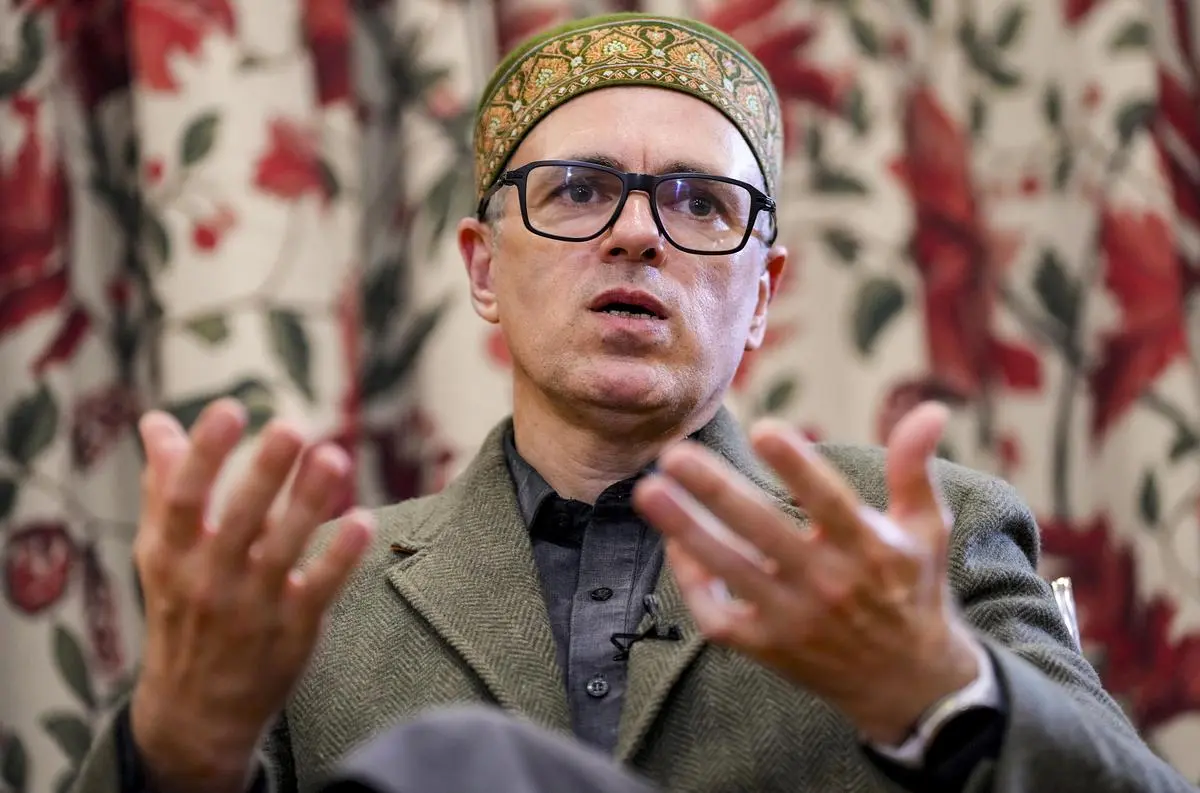
Jammu and Kashmir Chief Minister Omar Abdullah emphasized the need for the Tamil Nadu governor to grant TVK leader Vijay the opportunity to demonstrate his majority in the assembly. Abdullah’s statements come in light of the governor’s recent decision to deny Vijay the chance to form a government, citing a lack of requisite numbers.
Governor Rajendra Vishwanath Arlekar rejected Vijay’s claim on Thursday, asserting that the Tamilaga Vettri Kazhagam (TVK) does not meet the simple majority requirement necessary to establish a government in Tamil Nadu. The assembly is composed of 234 members, with a simple majority set at 118.
Despite support from the Congress party, which holds five seats, Vijay’s TVK still falls short of the needed majority. Abdullah argued that stopping Vijay from forming a government lacks justification, particularly considering several Supreme Court rulings that have reinforced the notion of inviting the single largest party to form a government.
“If we consider the Supreme Court’s ruling, then there should be no President’s rule in Tamil Nadu,” Abdullah asserted. He referenced multiple instances wherein the Supreme Court mandated that the largest party following elections should be afforded the opportunity to prove its majority on the assembly floor.
Abdullah recounted a precedent involving former Prime Minister Atal Bihari Vajpayee, who governed for just 13 days under similar circumstances. He noted that the President allowed Vajpayee to form a government without waiting to verify his numbers. “When Vajpayee did not have the numbers, he resigned,” Abdullah added.
“It is crucial that the Tamil Nadu Lok Bhavan recognizes this established protocol,” he continued, urging the governor to reassess the decision. “Vijay should be allowed to form the government, and then he should be provided an opportunity to prove his majority. If he succeeds, he remains; if not, he must resign,” Abdullah said.
The unfolding political situation in Tamil Nadu underscores the complex dynamics of power in state governance. With Abdullah’s statements resonating amid political discussions, the focus now turns to the potential ramifications of the governor’s decisions and the future of governance in the state.