


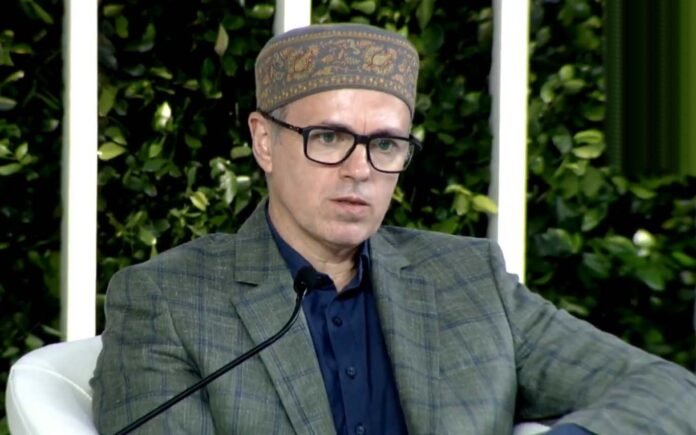
Jammu and Kashmir Chief Minister Omar Abdullah on Wednesday described his office as one of “disempowerment”, saying he is facing the “unique misfortune” of having transitioned from leading one of the country’s most empowered States to heading a Union Territory with powers “far less than any other State Chief Minister”.
Speaking at an event organised by a national newspaper, Abdullah delivered a candid critique of the present administrative arrangement in Jammu and Kashmir, alleging frequent interference by the Lieutenant Governor’s office and reiterating his demand for a clearly defined timeline for the restoration of Statehood.
Abdullah said he finds it “very difficult” to reconcile the terms “Union Territory” and “Jammu and Kashmir” in the same sentence.
“I hate being reminded that we are a Union Territory,” he said, adding that while officers never felt the need to emphasise the word ‘State’ during his earlier tenure, the UT status is now repeatedly highlighted.
Power Struggle with LG Office
Referring to what he termed an “asymmetrical” distribution of power, Abdullah alleged that the Lieutenant Governor, Manoj Sinha, continues to hold positions traditionally associated with an elected government. These include chairmanship of the Jammu and Kashmir Power Development Corporation and convening a tourism-related meeting in Gulmarg.
“What business does someone responsible for security have holding a tourism meeting?” he asked.
He further alleged that an IAS officer was appointed to a post reserved for the Jammu and Kashmir Administrative Services (JKAS) to deny the elected government control over the Information Department.
Abdullah said several cabinet decisions, including one related to modification of reservation percentages, remain pending with the Lieutenant Governor.
“There is an asymmetrical allocation of power between the elected and unelected government,” he said.
Statehood and Article 370
On the stalled restoration of Statehood, the Chief Minister reminded the Centre of the three-step process it had outlined—delimitation, elections and Statehood.
“Two steps are complete. Why are we made to wait for the third?” he asked.
Challenging the Centre to define what it means by “appropriate time”, Abdullah said the government must set a clear goalpost.
“If it is when the BJP comes to power, then be honest so people can decide,” he said.
On the restoration of Article 370, Abdullah said it would only be possible after a change of government at the Centre.
“It is pointless asking the people who took it away from us to give it back,” he said, adding that while he remains committed to special status, he would not “fool the people” with unrealistic promises.
Radicalisation and Governance
The Chief Minister warned that “hyper-nationalism” and collective punishment were contributing to radicalisation. He strongly criticised the practice of demolishing houses following terror attacks.
“You demolished 10 or 12 houses after the Pahalgam attack, only to later find there was no Kashmiri involvement. If those people are radicalised, whose fault is it?” he asked.
He also cited recent controversies related to sports teams and medical college admissions, where objections were raised because the majority of selected candidates were Muslims.
“When you push an entire community to the margins, how can you expect no reaction?” he said.
National Politics and EVM Debate
On the national political front, Abdullah described the INDIA bloc as frequently being in the “ICU” or on “ventilator support”, acknowledging that issues like Article 370 are currently not on its agenda.
He defended Congress leader Rahul Gandhi’s silence on the issue, saying, “I’d like him to win an election first before I can have this conversation. In the present environment, he cannot win if he raises this issue.”
Breaking from his father Farooq Abdullah’s stance, Omar Abdullah rejected allegations of EVM tampering.
“My father believes strongly in machine chori… but I believe we should own our defeats and correct our mistakes,” he said, instead blaming constituency delimitation for electoral disadvantages.
Economy, Environment and Tourism
Earlier, Abdullah also spoke about environmental challenges, including pollution and prolonged dry spells in Srinagar, noting that the valley’s geography traps smog.
He sought to correct what he called a “misconception” about tourism being the sole economic driver of J&K, stating that tourism ranks fourth in contribution to the Gross State Domestic Product, behind agriculture, horticulture and industry.