


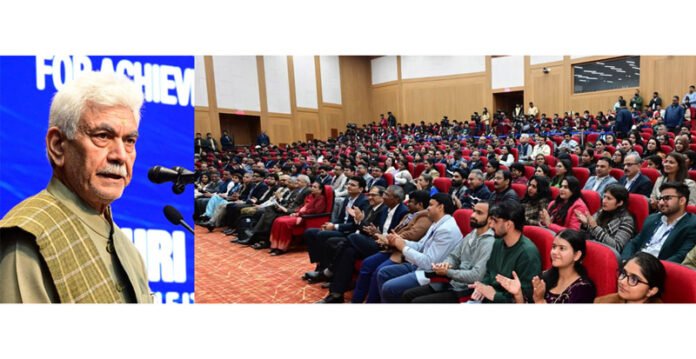
On Monday, Lieutenant Governor Manoj Sinha reported that large parts of India have effectively expelled terrorism, particularly highlighting the drastic drop in local recruitment of terrorists in Jammu and Kashmir.
Speaking at the Strategic Management Forum Conference at IIM Jammu, Sinha noted that most of the northeastern states are now virtually free from terrorist activities. He affirmed the reduction of threats from left-wing extremism and Naxalism, claims that underline the government’s effective approach toward counter-terrorism.
“Large parts of the country have been freed from terrorism. Except for a few pockets, most of the northeast has become terrorism-free. The threat of left-wing extremism and Naxalism has now been confined to just two or three districts,” Sinha said, emphasizing the significant strides taken by security forces.
Refocusing on Jammu and Kashmir, Sinha highlighted that no prominent terrorist commanders remain active in the region. “Local recruitment into terrorism has seen a sharp decline. Hardly one or two youths are being recruited now,” he added, showcasing the positive trend in the fight against radicalization.
Despite these advances, Sinha cautioned against the continuing threats posed by infiltrators from Pakistan. He stated, “Those coming from across the border are hiding in dense forests and mountainous terrain. I assure you they will be eliminated. No matter how long it takes, they will not survive.”
During his address, Sinha outlined that the nature of terrorism has evolved, drawing in educated individuals as well. He insisted that combating terrorism requires a collaborative effort, stating, “The fight against terrorism cannot be left to security forces alone in regions like Jammu and Kashmir, parts of Karnataka and Kerala.”
Sinha called upon society and certain administrative wings to play an active role, marking a shift towards a more community-oriented approach in addressing such issues.
In addressing the divisive “insider-outsider” narrative, he urged an end to this mindset, which he believes obstructs developmental efforts. “Such thinking creates hurdles in the development process,” he remarked.
Shifting the focus to national goals, Sinha presented a vision for achieving a Viksit Bharat (Developed India) by 2047. He emphasized the role of policymakers and business leaders in navigating the complexities of a changing global landscape.
“Our focus should be on macroeconomic stability, high investment in education and health, digital tools, participatory governance, transparency, accountability, and speedy project implementation,” he stated, underscoring the need for long-term strategies to foster growth.
He further lauded India’s unprecedented growth trajectory under Prime Minister Narendra Modi, remarking on the renewed confidence among industrial leaders. “Manufacturing, services, village industries, handloom, and handicrafts are competing globally,” he said, linking this to the Prime Minister’s call for Swadeshi which encourages local products.
Highlighting the economic potential of Jammu and Kashmir, Sinha advocated for the exploitation of its mining resources. “With strategic planning, an additional annual revenue of Rs 15,000 crore to Rs 20,000 crore can be generated in the next five to seven years,” he asserted, pointing to the region’s untapped limestone, sapphire, and lithium reserves.
He also stressed the need to maximize the hydropower sector’s output and suggested amendments to the Holistic Agriculture Development Programme to better align with evolving economic needs.
During the event, Lieutenant Governor Sinha inaugurated the Basohli Painting Exhibition and presided over the valedictory session of a workshop celebrating this rich cultural art form. “Basohli Painting is our priceless artistic heritage with immense value for present and future generations,” he said, commending IIM Jammu and the Indira Gandhi National Centre for the Arts (IGNCA) for their collaboration.
The conference attracted numerous dignitaries, including Prof B.S. Sahay, Director of IIM Jammu; R.K. Chaudhary, Chairman JERC J&K and Ladakh; and Subash Chandra Meena, Economic Advisor from NITI Aayog, showcasing the convergence of expertise from various sectors.