


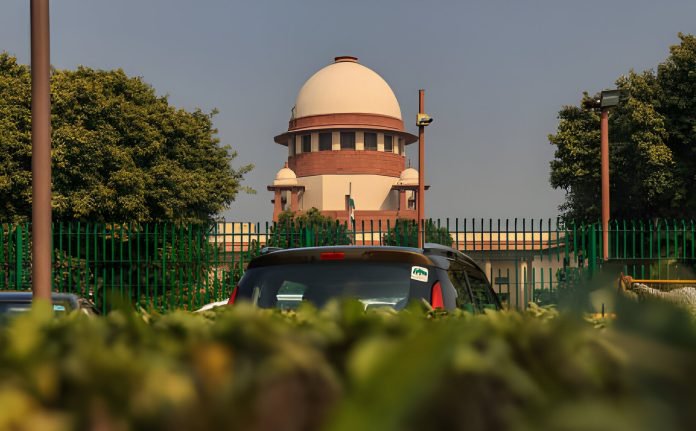
The Supreme Court of India on Wednesday referred the crucial issue of whether litigants can approach high courts directly for anticipatory bail to a three-judge bench. This significant decision arises amidst ongoing debates about judicial processes in various states.
A bench comprising Justices Vikram Nath and Sandeep Mehta expressed that the matter requires thorough examination by a larger bench, stating, “This matter requires to be heard by a three-judge bench.”
This legal discourse comes in light of the apex court’s earlier decision to appoint senior advocate Siddharth Luthra as amicus curiae to bring clarity on this pressing issue.
The Supreme Court had previously voiced serious concerns regarding the Kerala High Court’s practice of directly entertaining anticipatory bail applications. During a hearing on September 8, the court noted, “One issue that is bothering us is that in the Kerala High Court, anticipatory bail applications are regularly entertained directly. Why is that so?”
The bench indicated that there seems to be a deviation from established legal protocols that require accused individuals to first approach the sessions court before seeking anticipatory bail from the high courts. This practice, unique to Kerala, has raised eyebrows among the judiciary.
Referring to the provisions outlined in both the old Code of Criminal Procedure and the new Bharatiya Nagarik Suraksha Sanhita (BNSS), 2023, the court noted that a structured hierarchy exists for bail applications. Section 482 of BNSS specifically addresses directives for granting bail to individuals anticipating arrest.
The justices remarked, “It doesn’t happen in any other state. Only in the Kerala High Court… applications for anticipatory bail are regularly entertained directly.”
The discussions were sparked by a plea filed by two individuals contesting a Kerala High Court order that denied their request for anticipatory bail. These petitioners approached the high court directly, bypassing the sessions court entirely.
The Supreme Court emphasized that this indirect approach may lead to inadequate factual records being submitted before the sessions court. The bench questioned, “Are we inclined to consider whether the option to approach the high court is a matter of choice for the accused or whether it should be mandatory to first go to the sessions court?”
To delve further into this matter, the top court also issued a notice to the Kerala High Court through its Registrar General, seeking its official response. The broader implications of this discussion could significantly affect the future handling of anticipatory bail applications across Indian states.
This case marks a pivotal moment in understanding the complexities of judicial procedures related to anticipatory bail and the essential role of proper legal protocols in ensuring justice.